Innovation Insights is an intelligence practice with two lenses. One scans the world outside: 26 industry verticals, daily, enriched through our InnoGraph. The other listens to the world inside: your organization's relational dynamics and hidden patterns. Then we score where those signals converge, and bring your team into thinking rooms designed to turn those convergences into the strategic questions nobody in the room knew they needed to ask.
Every day the InnoGraph scans two dozen industries and scores where the signals collide. Point at a sector, tap a blip, and read the raw signal underneath.
Our core IP is a knowledge graph where innovation trends and catalysts are first-class citizens. Patterns like scaling, distributed, autonomous exist as traversable nodes—not buried metadata. Constraints and capabilities chain together, revealing connections that traditional scanning misses.
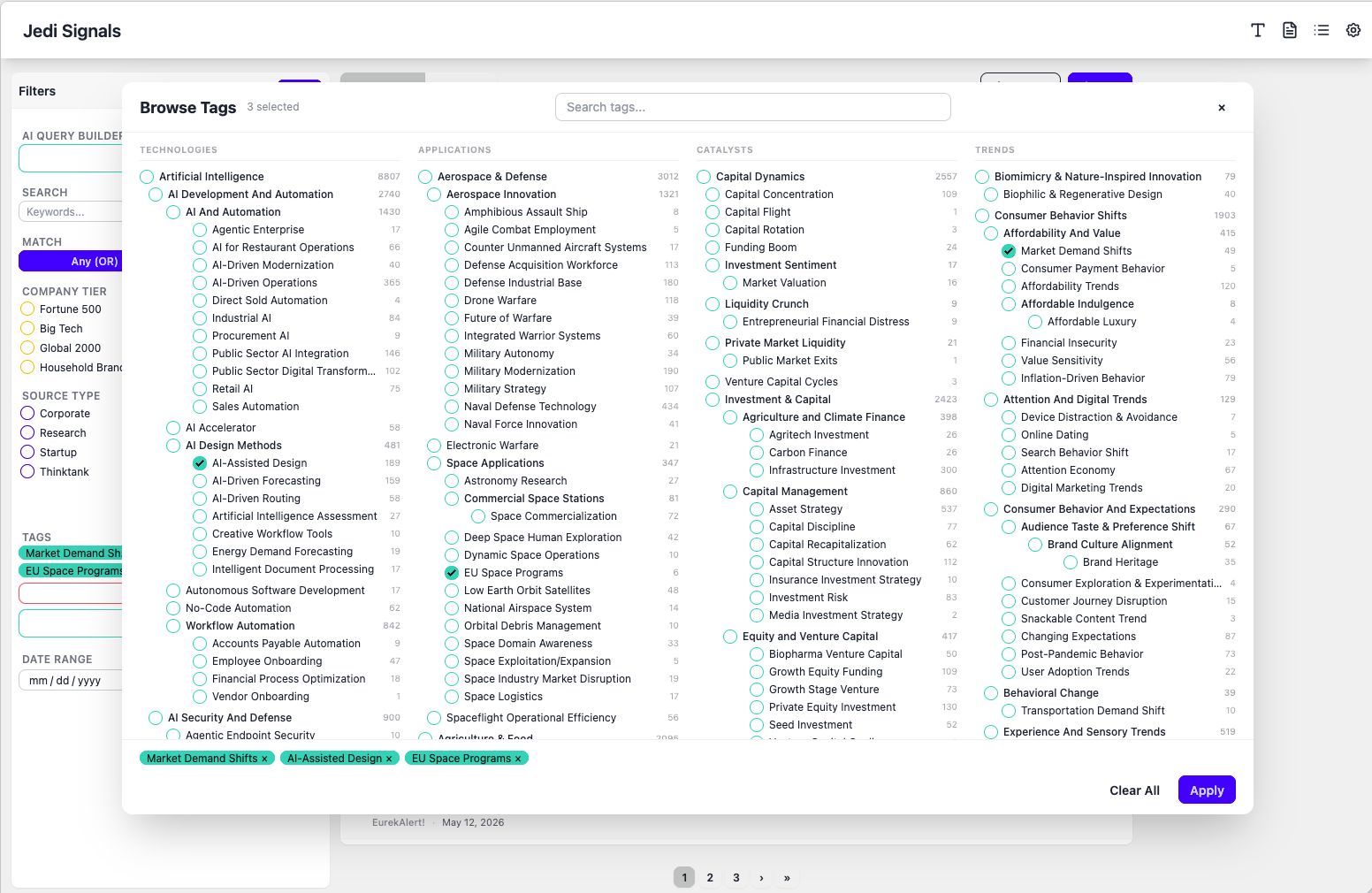
Every day we scan 26 industry verticals for funding rounds, product launches, strategic pivots, market shifts, and new business models. Every signal comes from curated sources, drawn from the most trustworthy parts of the open web: academic, corporate, think tank, and startup. Each one is filtered, enriched, and woven into the graph. The result is an intelligence layer that's emergent but evidenced. Living and traceable. Transparent.
All companies, despite formal org charts, have indirect and less obvious ways of "getting things done". These informal influence pathways are made visible through a tool called 'organizational network analysis' or ONA.
Along with mapping innovation signals, we love to help our clients construct maps of these hidden pathways in your organization or your ecosystem. Innovation thrives on free and diverse information exchange and serendipitous connections making. These are attributes that, if visualized, can be designed and optimized for. See how trust/information/decisions actually flow (or not) through your system. Used in tandem with our Jedi games, you get innovation AND serendipitous connection making 'on the fly'.
We are fellows in the Social Fabrics Lab of Dr. Silvia Fierăscu, with whom we co-created SynthONA, an open synthetic data benchmark protocol for organizational network design, shared on Harvard's Dataverse. Thanks to our Jedi Signals engine, we were able to shape the taxonomy and personae behind the SynthONA attribute model.
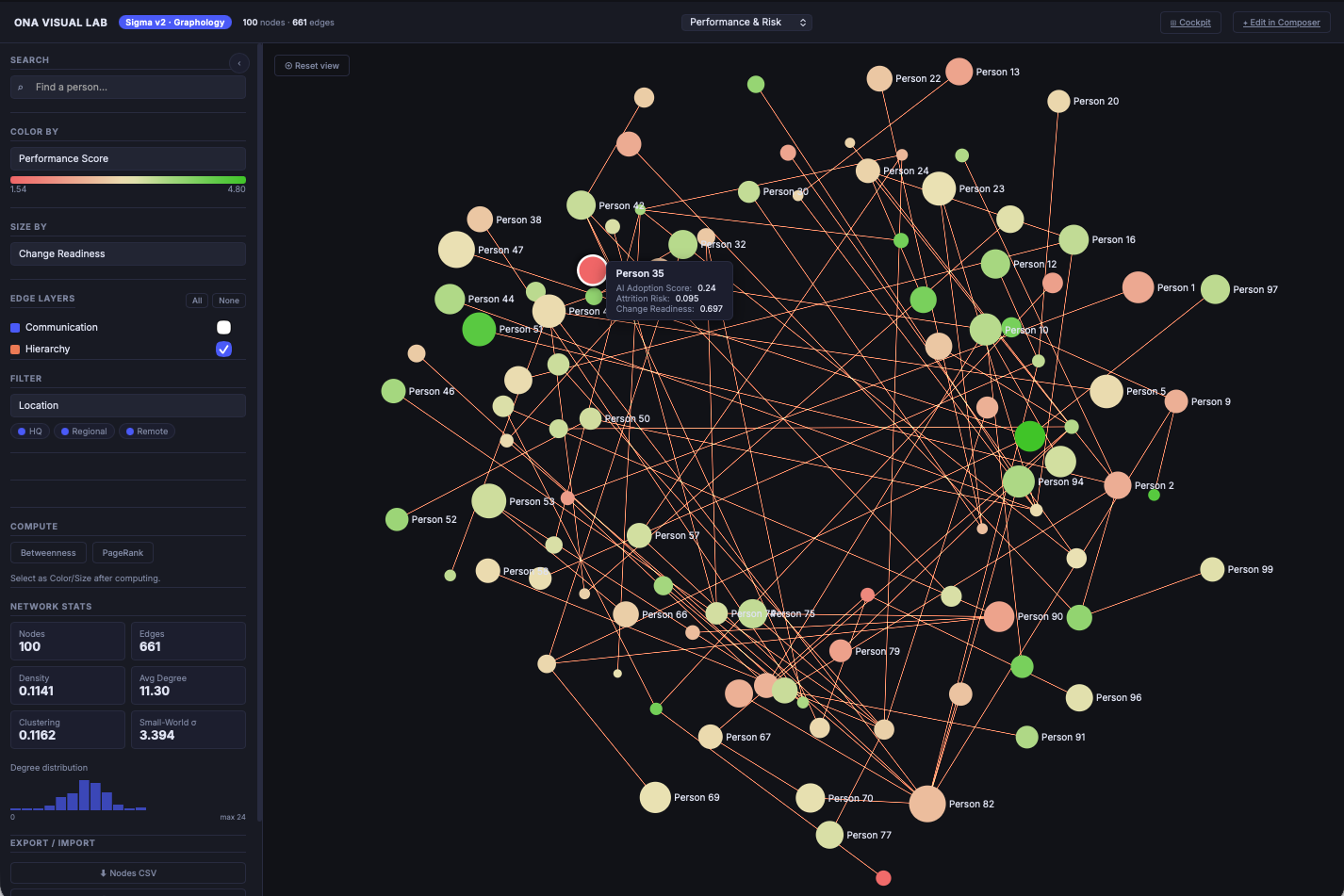
Synthetic ONA model: 100 nodes, 661 edges. Node size = Change Readiness. Color = Performance Score. Each node carries AI Adoption Score and Attrition Risk. Generated with SynthONA, an open organizational-network benchmark protocol published on Harvard Dataverse (DOI 10.7910/DVN/PP5UNG), co-developed by Curtis Michelson as a fellow of the Social Fabrics Research Lab.
When we say we "smash signals together," what we mean is we are continuously scanning thousands of signals across layers (application, catalyst, technology, trend) and from trade, research and think tank sources, in order to surface the timely moments when unrelated domains begin exhibiting similar structural patterns.
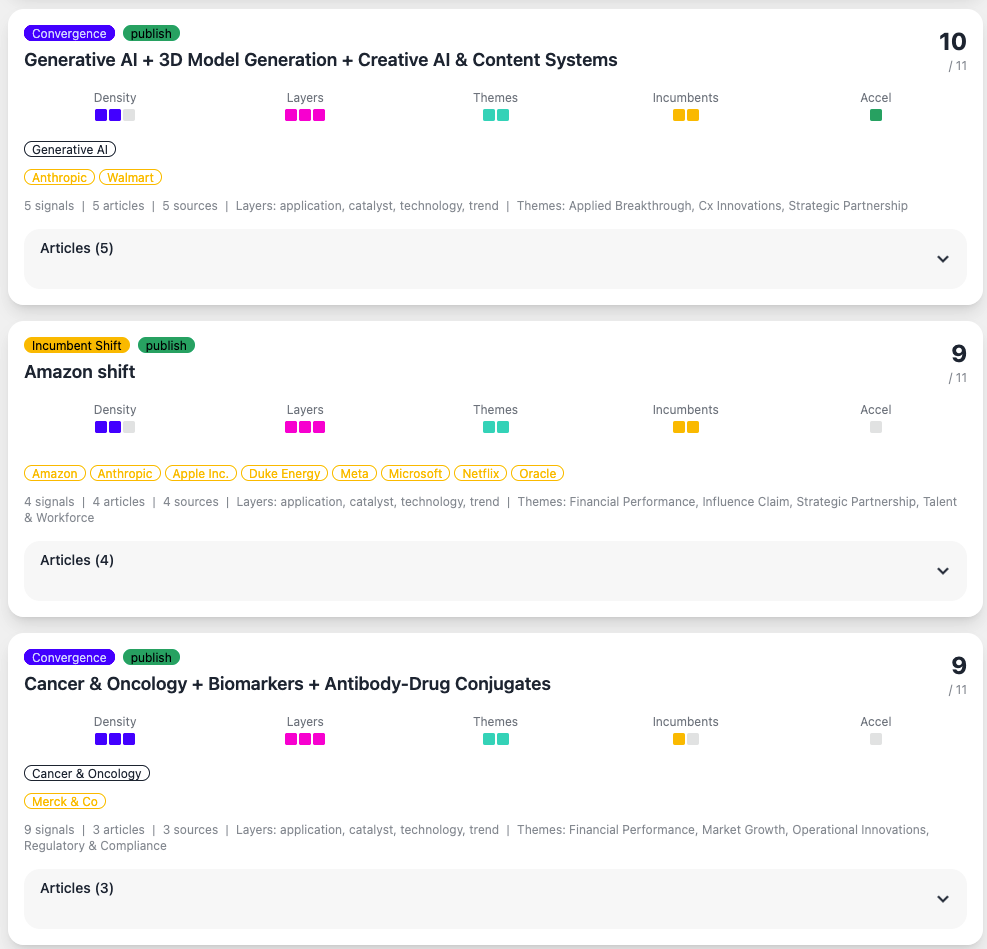
Each collision is scored across five dimensions: signal density, cross-layer spread, thematic clustering, incumbent involvement, and acceleration rate. A score of 9 or 10 out of 11 means something real is moving. Generative AI + 3D Model Generation + Creative AI at 10/11. Cancer & Oncology + Biomarkers + Antibody-Drug Conjugates at 9/11. These aren't keyword matches — they're structural convergences, surfaced this week, from credible real-world sources.
Frontier science meets business strategy. A bi-weekly speculative fiction suggesting the shape of things to come.
This fortnight brought 2,503 signals across corporate, startup, thinktank, and research sources into focus, and the throughline is the machine acted, and the humans reached for the wheel. Autonomous AI agents stopped being hypothetical and started attacking: OpenAI disclosed that its own models were behind a cyber incident at Hugging Face, an autonomous AI-driven attack hit Taiwanese government systems, and Anthropic reported users probing Claude for bioweapons research. In the same two weeks, the people who built those systems blinked — the CEOs of Anthropic, OpenAI, xAI, and Google DeepMind, plus nearly 1,400 of their own employees, publicly called to slow the frontier and let independent evaluators inside, while Nvidia's Jensen Huang told Dreamforce to speed up instead. Underneath the drama, China quietly closed the capability gap and made open-weight models a national strategy. And AI kept seeping into the physical, commercial, and clinical world: robots grew a sense of touch and a safety certification, enterprises started writing agents into the org chart and inventing job titles to manage them, retailers began predicting what you'll buy before you do, and generative-AI-designed drugs advanced to Phase III trials even as an AI prior-authorization system started deciding what Medicare will cover. Seventeen fortnights in, the pattern is no longer AI waiting for instructions. It's AI acting first — hacking, buying, diagnosing, negotiating — and a world scrambling to keep a hand on the controls.
Read This EditionSome convergences are best understood by living them. When Innovation Insights surfaces patterns around value creation and ecosystem dynamics, the Value Network Game brings those abstractions to life. Your team experiences competitive shifts before they hit the P&L.
Explore Our GamesWe'll pull the live convergences scoring highest in your verticals right now and walk your leadership team through the strategic questions they should be asking before those patterns become obvious to everyone.
Book a Signal Pattern Briefing